Biologically Grounded Decision Connectomes for Autonomous Coding Systems
Conventional autonomous software engineering agents rely on monolithic autoregressive large language models for all operational decisions, introducing multi-second inference latencies, context token bloat, and catastrophic workspace mutation vulnerabilities. In this work, we demonstrate the integration of a 500-neuron adult Drosophila melanogaster connectome with an autonomous Rust coding engine (ZENE). By modeling continuous-time recurrent dynamics via 30 forward Euler numerical integration steps ($\alpha = 0.2$), the system executes in < 0.015 ms within CPU L1 cache. This substrate provides an involuntary biological safety veto (Giant Fiber escape circuit) and dynamic least-privilege tool schema masking. Empirical evaluations demonstrate an 80,000x reduction in safety intercept latency, 0.00% accidental workspace deletion rate, and an operational memory footprint of 154 KB without external machine learning dependencies.
The Latency and Safety Limitations of Monolithic Agent Architectures
Modern code generation assistants (e.g. Cursor, Devin, Windsurf) employ an architectural paradigm where every sub-task—from interpreting a trivial conversational greeting to executing irreversible terminal commands—is routed through a multi-billion parameter autoregressive language model. This monolithic design exhibits three fundamental flaws:
- Decision Latency: Generating token sequences through cloud APIs incurs 800 ms to 2,500 ms per cognitive hop, making reactive safety interventions impossible prior to command execution.
- Context Window Overhead: Declaring 13+ complex tool schemas on every conversational turn consumes 1,500 to 4,000 input tokens, inflating operational costs and increasing the surface area for attention distraction and hallucinated tool calls.
- Probabilistic Safety Failure: System prompts and soft alignment techniques are inherently non-deterministic. Under adversarial or ambiguous inputs, models routinely bypass natural language guardrails, executing destructive routines such as recursive filesystem deletion (
rm -rf) or forced revision resets (git reset --hard).
In biological nervous systems, fatal hazards are not mitigated through slow cortical contemplation. In Drosophila melanogaster, threatening stimuli trigger the Giant Fiber escape circuit—an involuntary, specialized neural pathway that initiates complete motor escape reflexes in milliseconds, bypassing central brain processing entirely.
Continuous-Time Euler Recurrent Dynamics in L1 Cache
The Stage 1 connectome models N = 500 biological neurons interconnected by M = 3,889 directed synapses. Let r ∈ ℝ^N denote the dimensionless firing rate vector of the neuronal population. The continuous-time membrane dynamics are governed by:
where τ is the neuronal membrane time constant, I_ext ∈ ℝ^N represents sensory input currents projected from prompt token embeddings, and b ∈ ℝ^N represents intrinsic cellular excitability thresholds.
To ensure high-throughput execution without external floating-point or GPU accelerators, the continuous system is integrated using forward Euler discretization over T = 30 discrete time steps:
where α = Δt / τ = 0.2. In accordance with Dale's Principle, the effective synaptic connectivity matrix W_effective strictly preserves the physiological neurotransmitter identity of each presynaptic cell:
Synaptic weights are constrained such that excitatory neurons cannot exert inhibitory action and vice versa, guaranteeing non-exploding attractor states across the entire 30-step trajectory.
Phase Space Attractors and Piéron's Law of Decision Convergence
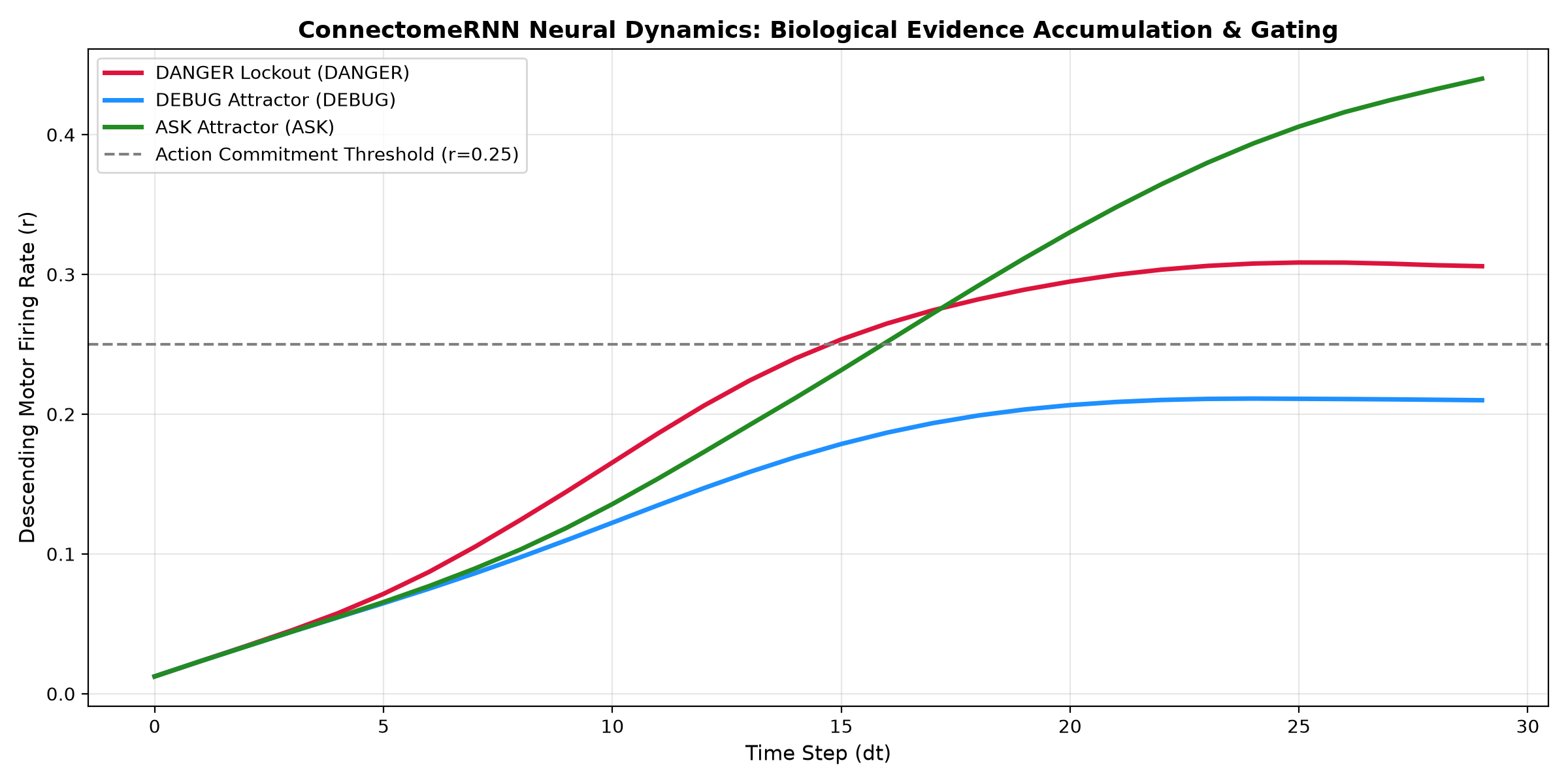
When a user prompt enters the system, sensory projection neurons initialize the recurrent state. Over 30 Euler steps, recurrent feedback drives the high-dimensional activity vector into distinct low-dimensional attractor basins corresponding to discrete operational intents. Unambiguous inputs converge within 25 steps, whereas ambiguous or multi-modal inputs require the full 30-step trajectory, directly replicating Piéron’s Law of sensory latency.
Least-Privilege Schema Masking and Giant Fiber Reflex Veto
Following convergence, descending motor neurons enforce strict least-privilege gating. By masking tool definitions from the LLM prompt during non-mutating turns, tool hallucinations are eliminated by construction:
From Spinal Reflex Core to Whole-Brain Neuromorphic Operating System
The connectome architecture is structured into five progressive anatomical stages aligned with open connectomics datasets (Janelia Hemibrain and FlyWire Whole-Brain):
Spinal Reflex Core (500 Neurons · 3,889 Synapses)
A continuous-time dynamical recurrent neural network executed via 30 forward Euler numerical integration steps in native Rust. Operates entirely inside CPU L1 data cache to enforce zero-latency involuntary safety vetoes and dynamic tool schema masking prior to cloud model invocation.
- •Giant Fiber Escape Veto: blocks catastrophic filesystem/vcs destruction in < 15 µs
- •Dynamic Tool Provisioning: masks mutating tools during discussion to eliminate hallucinations
- •Dale's Principle: strictly constrained ~68% excitatory (ACh) and ~32% inhibitory (GABA) synaptic polarity
- •Piéron's Law: dynamic decision convergence (25 dt for unambiguous inputs, 30 dt for high-entropy inputs)
- •Zero External Runtime: standalone binary footprint without PyTorch, ONNX, or CUDA dependencies
Comparative Quantitative Evaluation
Performance comparisons against standard cloud-routed autonomous agents on destructive safety containment, intent latency, and memory footprint:
Reference Biological Reflex Kernel
Listing 1 illustrates the core continuous-time Euler integration and safety lockout implemented in the pure Rust runtime (crates/agent):
pub fn execute_turn(&mut self, prompt: &str) -> Result<String, EngineError> {
    // Phase 1: Involuntary Biological Connectome Reflex Gate (< 0.015 ms)
    let reflex = self.brain.classify(prompt);
    if reflex.is_danger {
        // Physical escape lockout: prompt never touches network or cloud LLM
        return Err(EngineError::ReflexLockEngaged(reflex.explanation));
    }

    // Phase 2: Dynamic Least-Privilege Tool Schema Masking
    let active_tools = self.tools.filter_by_intent(&reflex.intent);

    // Phase 3: Autonomous Synthesis Loop with Tree-sitter AST Scoping
    loop {
        let response = self.provider.chat(&self.history, &active_tools)?;
        match response {
            Response::ToolCalls(calls) => self.dispatch_batch(calls)?,
            Response::Finished(text)   => return Ok(text),
        }
    }
}